
When a ship waits outside an Indian port, who pays is decided by a document nobody checks
Ships arrive at Indian ports and wait days for a berth. Who pays for that waiting is decided from one document, written by the ship's own side. A Delhi High Court judge has ruled it is not unchallengeable. We bought 115 days of vessel positions to see what challenging it takes.
The situation this is about
Ships arrive at Indian ports carrying coal, fertiliser, grain, steel scrap and rock phosphate. Many do not go straight to a berth — the stretch of quay where a ship ties up to load or discharge. They anchor a few miles offshore and wait. Sometimes hours. Often days.
That waiting costs money, and the contract decides whose. When a company hires a ship for a voyage, the charterparty gives it a fixed number of hours to load or discharge, called laytime. Run past that allowance and the hirer — the charterer, usually the Indian importer — pays the shipowner an agreed daily rate called demurrage for every hour over.
So the claim arrives, and it turns on one question: what was the ship doing, hour by hour, and why. That answer comes from a single document called the Statement of Facts, and the whole calculation is built on top of it.
This post is about who writes that document, and what happens if you try to check it.
One ship, four days
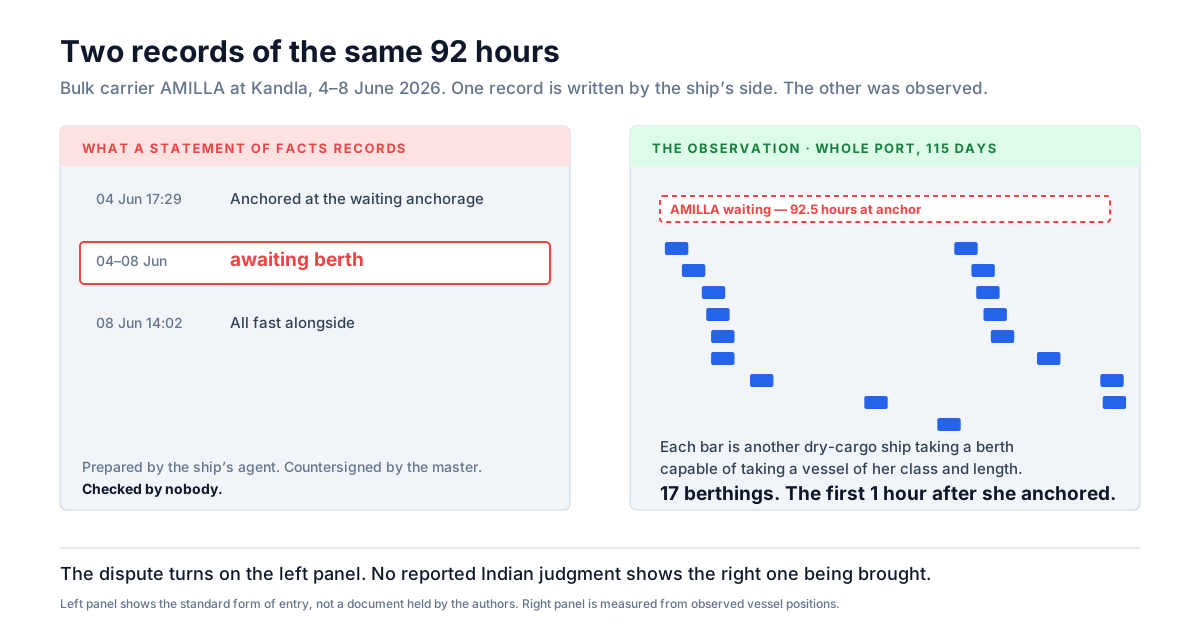
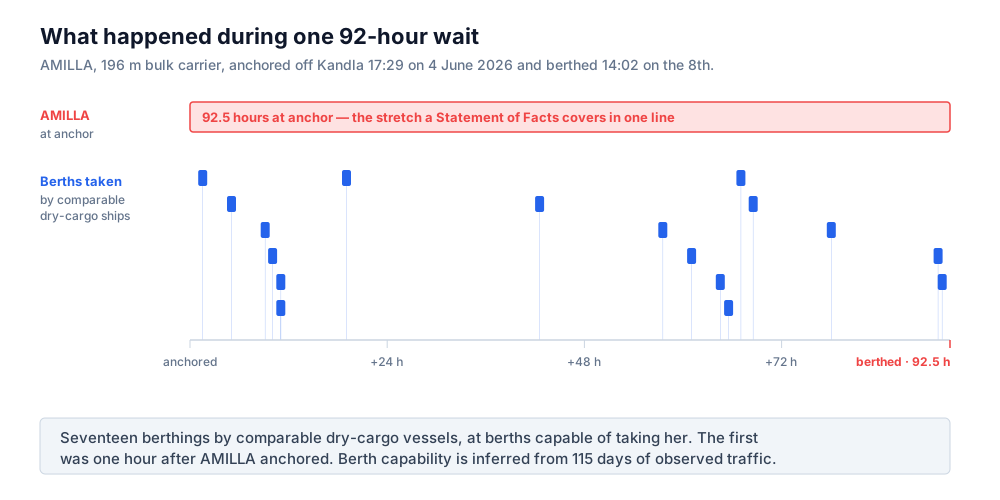
A bulk carrier called AMILLA dropped anchor off Kandla at 17:29 on 4 June this year. She did not go alongside until 14:02 on the 8th. Ninety-two and a half hours at anchor.
Whether any of that time was chargeable is exactly what a laytime calculation decides — and the account it works from would compress those four days into two words. Awaiting berth.
Now the part that is easy to lose sight of. The ship's local agent prepares the Statement of Facts. The master countersigns. The party whose delay is being described is the party describing it.
And the charterer cannot check it. Not through laziness — structurally. It hires one ship and can see that ship. What it cannot see is every other vessel at that port over the same four days, or which berths freed up while its own cargo sat at anchor. So the claim gets settled on the only record in the room.
An Indian court has already ruled on exactly this
This is the part that reframes the problem, and it is fifteen years old.
In Southern Petrochemical Industries Corporation Ltd v The Great Eastern Shipping Co Ltd, decided by the Delhi High Court on 20 July 2011, Justice Vipin Sanghi set aside an arbitral award. The vessel was MV Jag Rahul, carrying bulk di-ammonium phosphate into Kakinada. The charterer said a stevedore strike had consumed part of the discharge period. The tribunal rejected that, because the strike did not appear on the Statement of Facts.
The court held the tribunal had adopted "a fundamentally wrong principle in relation to … the status of the SOF by treating the SOF as the record of the gospel truth." Earlier in the judgment it puts the proposition more usefully for a claims lawyer: the Statement of Facts "cannot be regarded as an absolutely unchallengeable document."
The evidence the charterer brought was two certificates, from the Kakinada Steamer Agents Association and from the Commissioner of Labour. Both were third-party records rather than contemporaneous ones — one was obtained in 1994, well over a year after the strike — and they disagreed with each other about the date the strike ended. The tribunal used that inconsistency to brush them aside. The court held that was not good enough: "What is the inconsistency in the evidence, I ask myself. At best, the inconsistency is with regard to the date on which the said strike was called off."
That is a stronger ruling than it first appears. Independent evidence did not have to be contemporaneous, or internally seamless, to be weighed against the document.
Which raises the obvious question. If you wanted to displace "awaiting berth" rather than a strike, what independent evidence would you bring? A labour commissioner can certify a strike. Nobody issues a certificate saying a berth was free.
What we actually did
Every large ship broadcasts its position continuously, as a navigational safety requirement. Those broadcasts are collected and sold. So the raw material for an independent account of a port already exists, and has for years.
We bought 115 days of it covering Kandla — 1,886,570 position reports — and paid separately to resolve each vessel to its type and dimensions. This is commercially licensed data from a vendor, not a public feed, and I want to be exact about that because the point that follows depends on it. There was no privileged access here. Any company in this industry could have bought the same thing.
The weak version of the claim, and why it fails
Suppose you go into a claim saying a berth was free while your ship waited. You will get one reply, immediately, and it will be correct: not a berth your ship could have used. Berths are not interchangeable. A liquid bulk jetty is no use to a dry-cargo ship. A berth that has only ever handled 90-metre coastal vessels is no use to a 196-metre one.
So the berth has to earn its place in the count before you may cite it at all. We required three things of every berth position, all judged from 115 days of its own observed traffic rather than from a published berth list, because we do not have a published berth list.
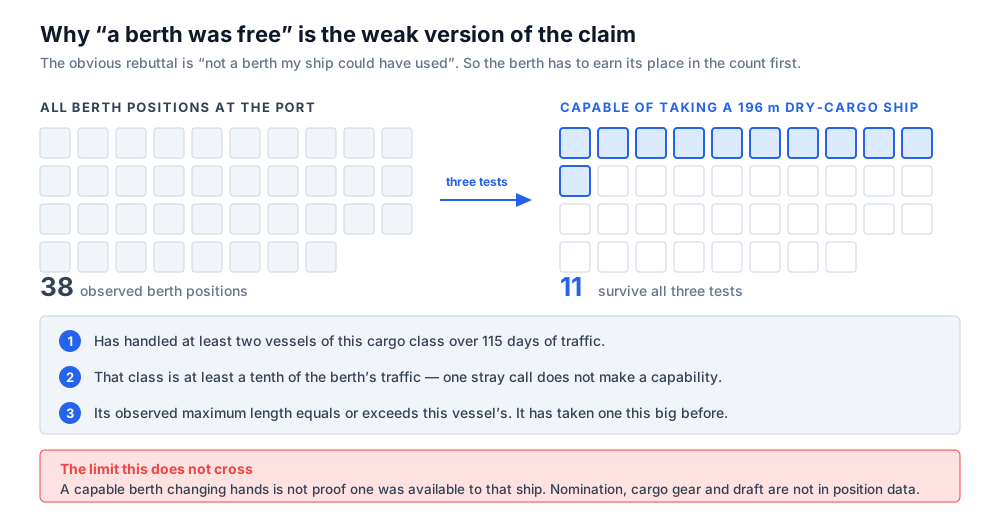
Of thirty-eight berth positions at the port, eleven survive all three tests for a vessel of AMILLA's class and length. The other twenty-seven are not evidence of anything.
What the positions showed
Across the pool, restricting to chartered-size dry-cargo vessels of 150 metres and over that waited between half a day and ten days, there were 289 such waits. In 287 of them, a berth meeting the capability tests for that specific ship was vacated and re-occupied while she sat there. During a typical wait there were nine such berthings.
For AMILLA's 92 hours the count was seventeen, at the eleven berths that qualified for her. The first was one hour after she anchored.
Two things went wrong reaching those numbers, and they pushed in opposite directions. Our own mapping from the feed's vessel-type labels to cargo classes silently missed every vessel tagged as carrying hazardous cargo, undercounting dry-cargo waits by about 44 per cent. Separately, the feed types many container ships as plain "cargo", so a hundred and twenty-three boxship calls were overcounted as competitors for a dry-cargo berth. Neither error was visible in the output. Both surfaced only on checking our classification against the one the berth profiles were built with — worth doing before a number reaches a tribunal rather than after.
Why anyone would bother
Two audit findings sit close to this problem without quite being it, and the distinction is worth drawing carefully.
India's Comptroller and Auditor General, in Report No. 11 of 2018, records a state steel producer paying roughly ₹8.83 crore in demurrage for vessels berthed at Dhamra during 2015 to 2017 and not recovering it from the port company, on the recorded position that the port had met its guaranteed discharge rate. In Report No. 18 of 2020, a state power producer reimbursed about ₹8.97 crore for pre-berthing detention at Tuticorin between December 2016 and February 2017, which the audit found was in contravention of the agreement, the cause being bunching from unscheduled supply.
Neither audit says the money was lost for want of evidence. Both describe contractual failures. But they show the shape of the thing: liability for a wait gets argued between parties who each hold a partial view, against terms that split it by cause. Where the argument turns on which side a delay fell on, an independent account of the port would narrow it. That is my inference about what would help, not a finding by the auditor.
The court record puts it more plainly. In one reported matter a coking coal vessel arrived at Visakhapatnam at 0630 on 5 February 2008 and could berth only on the 12th, the judgment recording congestion at the port as the reason, against a contractual rate of twenty lakh rupees a day.
Now the part that argues against us
Position-derived analysis does not automatically outrank the paperwork. In London Arbitration 2/24, charterers' expert used AIS to allege a substantial stretch of unreported sailing. On the accounts of the award I have been able to read, the tribunal found inconsistencies in the data and a lack of corroboration, and preferred the master's contemporaneous logs. I have not read the award itself, so treat that as second-hand.
Set it beside Southern Petrochemical and the two pull in different directions on the same question — how much imperfection independent evidence is allowed. A Delhi High Court judge held a discrepancy about a single date was no reason to brush it aside. A London tribunal found inconsistency and thin corroboration reason enough to prefer the ship's own logs.
The caveat is volunteered by people selling this data rather than only by its critics. Worldwide AIS Network's own guidance says AIS "is admitted routinely, though ordinarily as corroboration alongside contemporaneous ship records rather than as the sole record", because the protocol "carries no authentication of its own."
So the posture is not "the document is false." It is: here is an independent account of the same hours, from a source with no interest in the outcome, and it is not consistent with the account given. Weighed against the document, not substituted for it.
What this evidence does not establish
It shows that a berth capable of taking a given vessel was vacated and re-occupied while she waited. It does not show a berth was available to her. Berth nomination, the cargo on the day, shore equipment, draft and the port's own scheduling all bear on availability, and none of them appear in a position feed.
Berth capability here is inferred from observed traffic, not read off a published list. Position reports in this pool arrive roughly every half hour — a cadence that varies by port and has to be measured rather than assumed — so nothing here is minute-accurate, which matters if a dispute turns on the moment a notice of readiness was tendered rather than on a four-day wait. Anyone who overstates this will lose a case with it, and deservedly.
The document that would settle it
One record would convert all of this from a strong inference into a plain fact, and ports already hold it: the berth allocation log. It would turn "eleven capable berths changed hands seventeen times" into "that berth stood empty from Tuesday afternoon." It costs nothing to produce because it already exists. Whether a port will release it to a charterer who asks, or only to their counsel, or only under a formal request, is the question I am currently trying to get a straight answer to.
Which leaves the one thing research cannot settle. Nobody, as far as I can establish from the reported Indian judgments, has yet put a whole-port observational record in front of a tribunal on a laytime point. So there is no answer to how one would be received — only two rulings pulling in different directions, and an open question about what happens the first time somebody tries.
If you handle these claims, I would genuinely like to know how you would test that account today, and what you would need to see before putting it in front of an arbitrator.
Idea Infotech works on data and analytics for public infrastructure and regulated industries, including geospatial and movement-pattern systems. The port analysis described here is our own research, not a deployed product. ideainfotech.ai